
they lion
[note 2.18]

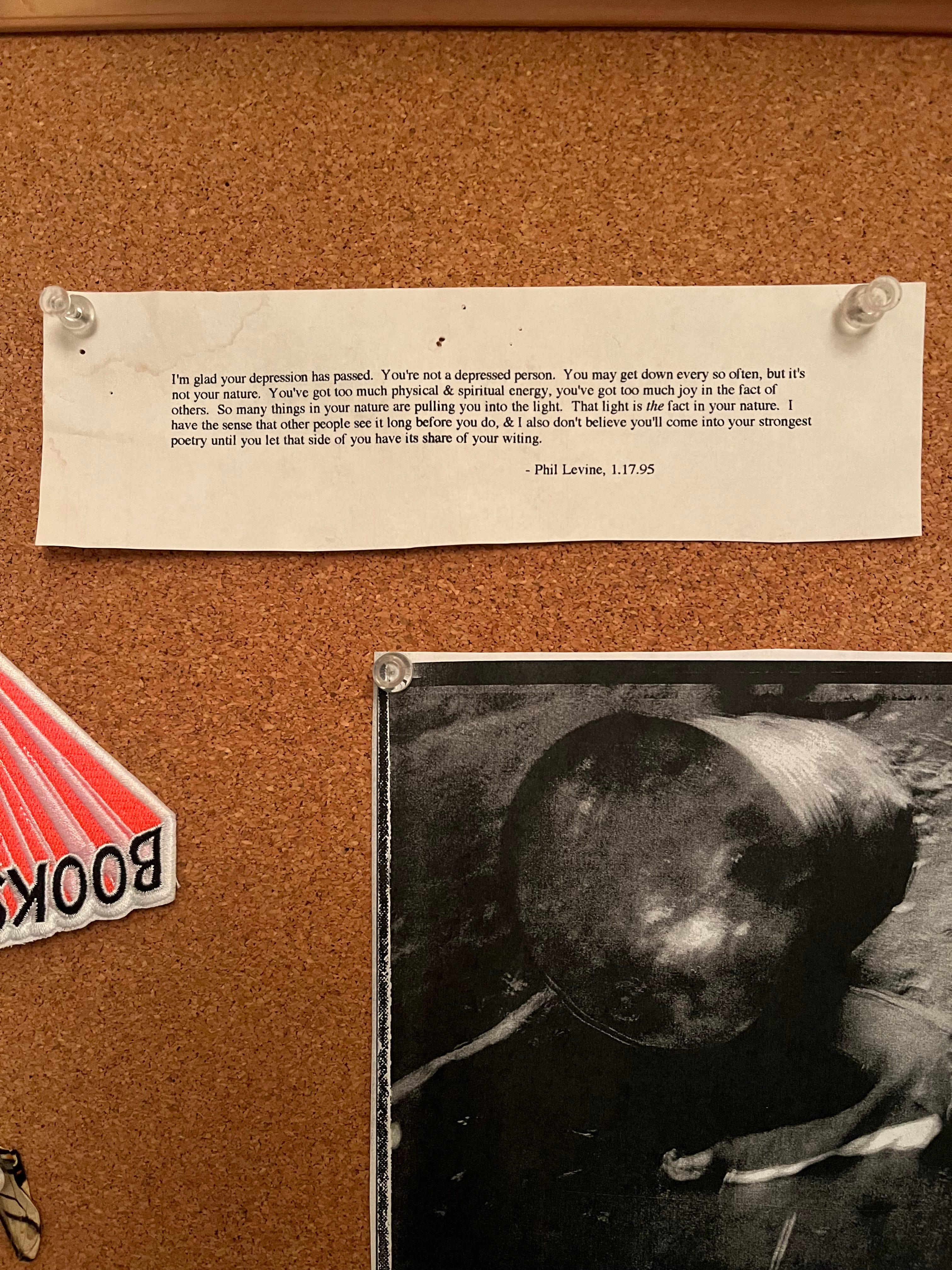
[detail of bulletin board over my desk]
I’m glad your depression has passed. You’re not a depressed person. You may get down every so often, but it’s not your nature. You’ve got too much physical & spiritual energy, you’ve got too much joy in the fact of others. So many things in your nature are pulling you into the light. That light is the fact of your nature. I have the sense that other people see it long before you do, & I also don’t believe you’ll come into your strongest poetry until you let that side of you have its share of your writing.
—Phil Levine, 11 jan 1995
I have carried these words with me for over thirty years now. I was thirty-five when Levine wrote this to me; he’d just turned sixty-eight (his birthday is 10 jan). At this moment I cannot remember how I got these words, but I believe it was via a handwritten letter.
This would have been only a year or so after I’d taken a workshop with him at NYU—meeting him turned out to be the reason I went to NYU, though I didn’t know it when I began.
I know we stayed in touch. I was traveling a lot then, I’d send him postcard, letters. If he was giving a reading I’d show up. I know that at this moment in my life my girlfriend (who I’d met in Sharon Olds’ workshop) had dumped me, and I was drifting, unmoored. The holidays had always been a dark time of year for me; maybe he sent me a letter, asked how I was, and so I told him, though apparently ending it with something to the effect that it, the sadness, was behind me, even if it wasn’t (sounds like something I’d do).
This was before I even owned a computer, let alone an email address. But I did have a typewriter, and so I typed out these words and have carried me with them ever since. For some reason, a couple years ago, they made their way onto the bulletin board over my desk.
I began writing Blind Huber around this time, which is, in some ways, was my attempt to access that light:
. . . .Clinging we
pull our bodies
across a chain of bodies, become
the chain, climb nothing,
always
up, toward suns, line them up
inside us, a flower taken whole,
a field built inside. It rises.
Each blade, each sun
[excerpted from “Inside Nothing”]
