
hands
[note 2.5]

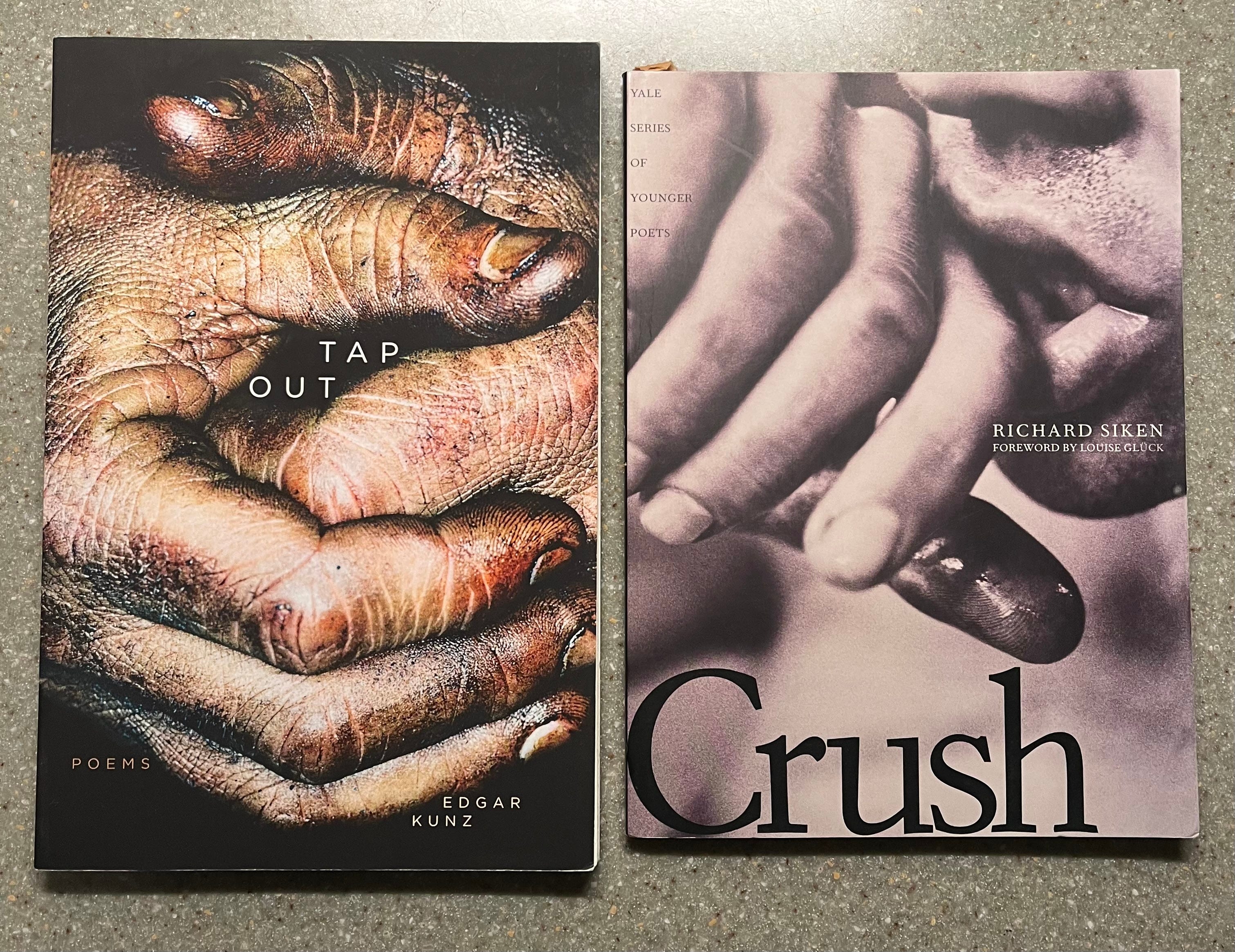
[above: some poems we cannot teach]
Dear Reader,
Here on Notes on Bewilderment, for the past couple weeks, I’ve been chronicling what’s happening in Texas around free expression and censorship. You may roll your eyes and say, Of course, it’s Texas, what do you expect? It’s what I did when, last fall, I heard that Texas A&M had banned Plato because one of his symposiums presents Aristophanes’ arguments on gender (take-away—homosexuality exists!). It felt like an Onion headline—PLATO BANNED—and it opened A&M to international ridicule.
I teach at the University of Houston, miles away from A&M. I told myself it was a one-off. I told myself, it wouldn’t happen here, even as it was happening. Just as you may be saying this couldn’t happen to you (unless, of course, you are affiliated with Harvard or Columbia).
Laws were being passed; Compliance Oaths were being drafted; our syllabi were being fed into an AI machine that would determine if we were teaching anything considered, what? subversive? Anti-American? Anything that talked about slavery or indigenous genocide or queer experiences? One thing was this: no one knew exactly what would trigger the AI machine to drag you before an ombudsman to explain why you were teaching a particular poem. The whole point it seemed was to self-censor.
Then I was presented with a “Required Compliance Oath.” If I signed, here’s a few poems, it seems, I won’t be able to teach:
It was night for many miles, and then the real stars in the purple sky,
like little boats rowed too far out, / begin to disappear.
[from “The Dislocated Room,” in Crush, by Richard Siken]
Siken’s book has a lot of gay sex in it, some of it rough, all of it rendered with an awful beauty. I taught Crush last week to my undergrads (all of whom, by the way, have seen Heated Rivalry)—I now await the machine.
And this:
Three hundred // miles north, my father beds down in a van by the Connecticut river.
Snow tires rim-deep in the silt. He has a wool horse blanket // tacked inside the windshield….
[from “After the Hurricane,” in Tap Out, by Edgar Kunz]
Kunz’s book presents an America that is anything but great again. It begins with a father living out of his van down by the river. It circles around desperation and our damaged system of masculinity (as Adrian Matekja put it).
Twenty years separate these books. Crush appeared at the beginning of our endless war with Iraq (or was it with Afghanistan? Which one bombed us on 9/11?). Tap Out appeared at the end of Trump One.
We have just started another war, this one with Iran.
Day one we bombed a girl’s school. Killed over fifty girls. My daughter is eighteen. Yesterday we killed over fifty girls.
Our war on Gaza has not yet ended, not really. Day one in Gaza we destroyed all the libraries. That’s another way to get rid of subversive texts.
As I have mentioned before, I respectfully refused to sign the Required Compliance Oath. At least I signed my letter respectfully, but really, it is hard to have any respect for such venality.
~~~
Note: I’m doing an event with Edgar at AWP this week: it’s called I COULD NOT STOP FOR DEATH, a panel sat at 10:30.
Here’s my schedule at AWP, stop by and say hi.
THURS
5-6:30 UH CWP MIXER / diamondback brewing co. / 1215 e fort ave #008
7 VIVA BOOKS / PINK TREE PRESS & FRIENDS [off-site reading] / 326 n charles st
w/ kim addonizio, jane lecroy, madeline artenberg, phillip giambri, linda kleinbub
FRI
11 BOOK SIGNING / WW NORTON / norton booth (#1157)
SAT
10:35-11:50 PANEL DISCUSSION / I COULD NOT STOP FOR DEATH
[poets on addiction and substance abuse]
w/ stevie edwards, edgar kunz, k.iver, joan kwon glass
room 320, level 300, baltimore convention center
session code: S141
