
film
[note 2.25]

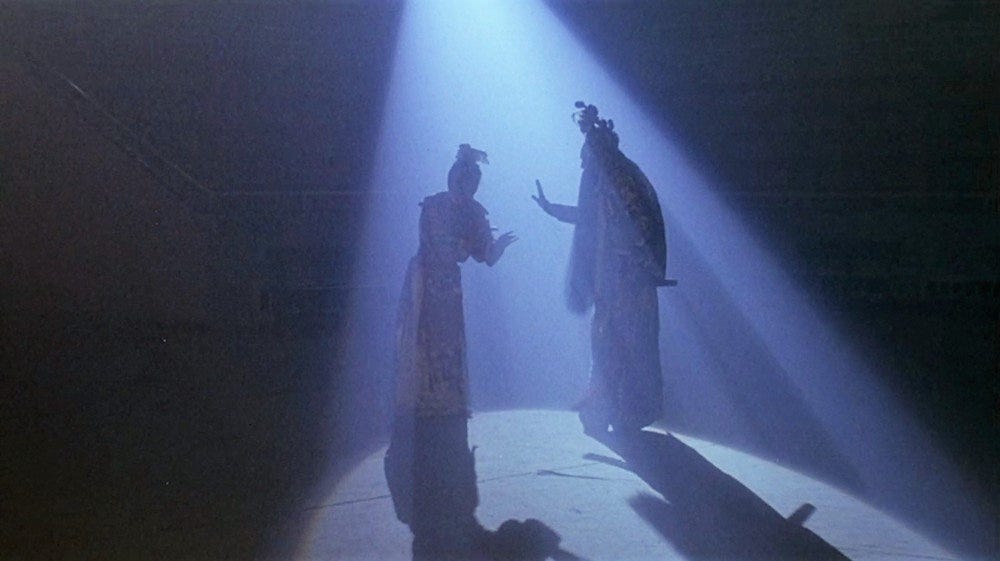
[film still from Farewell My Concubine]
After he got sick, Richard and I would watch each Gong Li film as they came out—Red Sorghum; Ju Dou; Raise the Red Lantern; The Story of Qiu Ju—one after the other, one every year, a flourish of beauty before China shut it down again.
Each was directed by the great Zhang Yimou.
Gong Li, Richard declared, was the most beautiful woman in the world. We were lying side-by-side on his bed, watching the tv that had been my grandmother’s.
I agreed, like I always did.
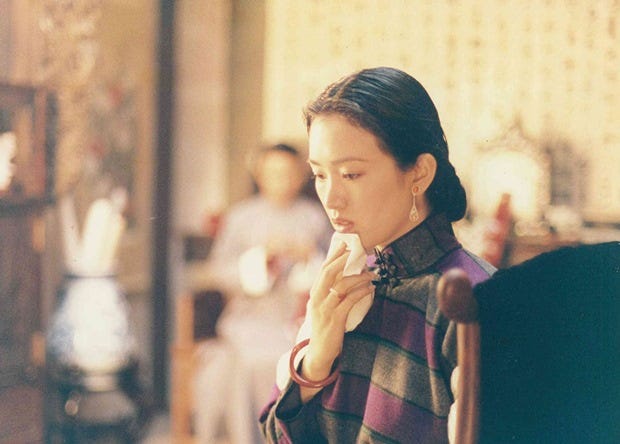
The last Gong Li film we saw was Farewell My Concubine (directed by Chen Kiage). It’s the story of two friends, Xiaolou and Deiyi, actors in a traveling theater troop performing the opera Farewell My Concubine. During the performance, Xiaolou’s made-up like the fifth member of Kiss, swinging a sword over his head. Deiyi plays his concubine (Deiyi’s mother had been a prostitute, so (like all of us) he’s returning to the source). They’d grown up together, street urchins taken in by the troop. The training was brutal; it was always cold, they were often beaten. Outside the theater, a body went unnoticed for weeks in an alley: the feet sticking out, frozen in a box, left as a warning—this is where you came from, this is where you will return.
In the opera, Deiyi sings, I am by nature a boy, not a girl, but he keeps inverting the lines—I am by nature a girl, not a boy—and for this he is (again) beaten.
Deiyi is (tragically) in love with Xiaolou, but Xiaolou ends up marrying Juxian (Gong Li).
Many years pass. They become opera stars, until the Cultural Revolution, followed by the Gang of Four, declares them tools of capitalism. Deiyi becomes addicted to opium, attempts suicide. It’s a story of friendship and addiction and unrequited love.
Gong Li looks straight at us, still the most beautiful woman in the world.
The leaves have all fallen so we can see the harbor now.
This film is about us, I think.
~~~
