
eros
[note 2.19]

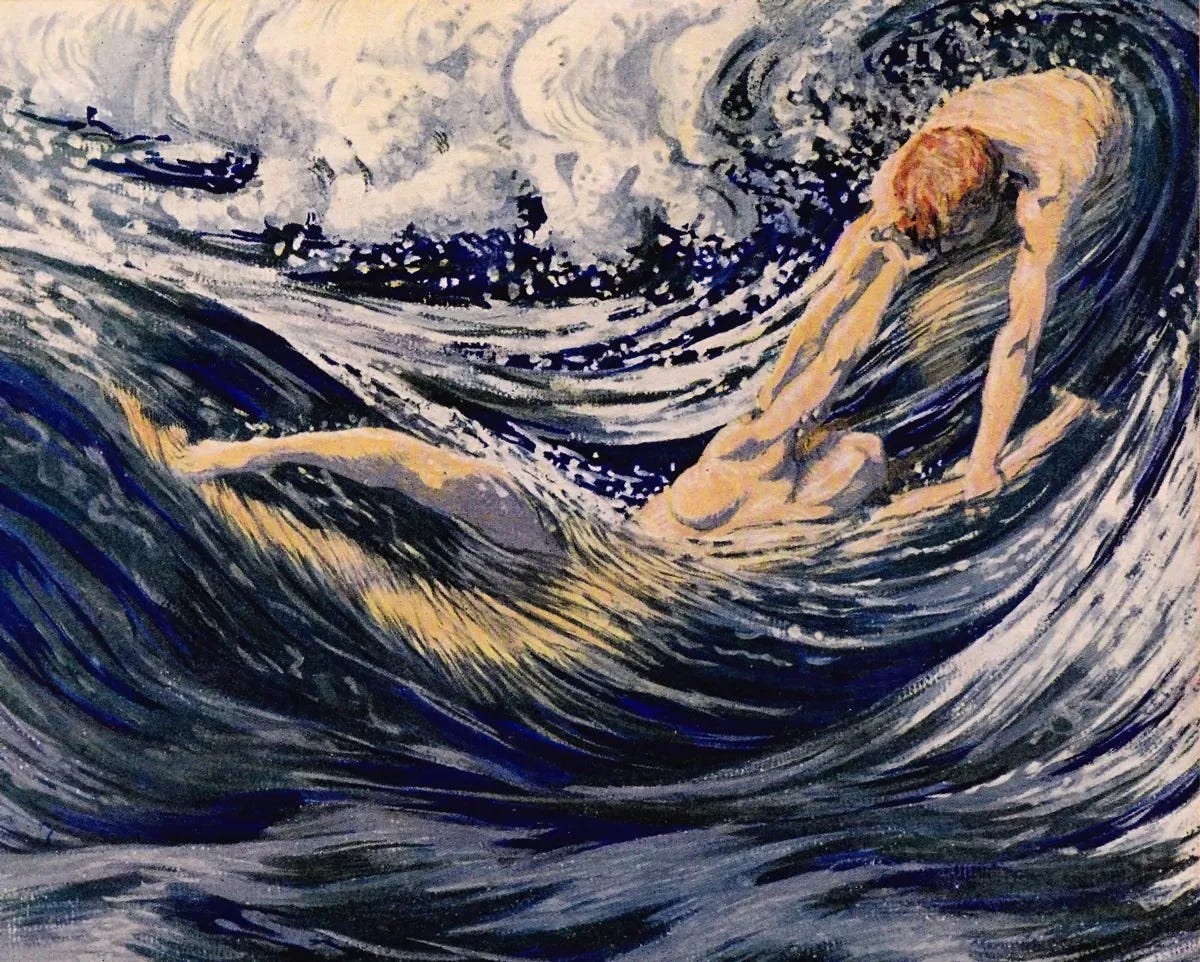
[illustration by Margaret C. Cook for a rare 1913 edition of Walt Whitman’s Leaves of Grass. (available as a print). This image came to me via The Marginalia]
In Eros the Bittersweet Ann Carson writes, “that which is known, attained, possessed, cannot be an object of desire.” I bring this up in a recent conversation with my friend Marie Howe, we are talking about the erotic poems we want to teach, we name some contemporary poets who bear down on that energy, that life force (Danez Smith, Natalie Diaz, Sharon Olds, Carl Phillips, Galway Kinnell, Dorianne Laux, to name a few). Then I say I would include Marie herself in that list as well (though we are both loathe to teach our own poems for some reason).
Her poem “How the Story Started” begins:
I was driven toward desire by desire
believing that fulfillment of that desire was an end.
There was no end.
This seems to embody one of Carson’s theses, that it is longing that drives eros.
Here’s another of Marie’s poems:
THE LETTER, 1968
That he wrote it with his hand and folded the paper
and slipped it into the envelope and sealed it with his tongue
and pressed it closed so that I might open it with my fingers.
That he brought it to the box and slipped it through the slot
so that it might be carried through time and weather to where
I waited on the front-porch step.
(We knew how to wait then—it was what life was,
much of it.) So, when the mailman came up the walk and didn’t have it,
he might have it the next day or the next, when it bore the mark
of his hand who had written my name, so I might open it and read
and read it again, and then again and look at the envelope he’d sealed
and press my mouth to where his mouth had been.
One thing I love about this poem is the way it stays with the object (the envelope) and allows the slow description of its life to slowly reveal the erotic tension.
